
Why We Score Everything: The Case Against Trusting Your Own Palate
There is a particular failure that recurs in specialty trading, and it usually starts with a genuinely good cup of coffee.
A buyer tastes something exceptional at origin. The producer is impressive, the story is compelling, the setting is beautiful. Enthusiasm builds through the conversation, and by the time the buyer is on the plane home a commercial relationship feels inevitable. Six months later the second shipment is inconsistent, the producer has never handled an export order of that size, and a roastery in Braamfontein has a menu commitment it cannot fulfil.
Nobody lied. Nothing was defective. The coffee really was exceptional. The buyer simply evaluated one dimension thoroughly and four dimensions not at all.
We built the Origin Index™ because we did not trust ourselves to avoid this on judgement alone.
What it actually is
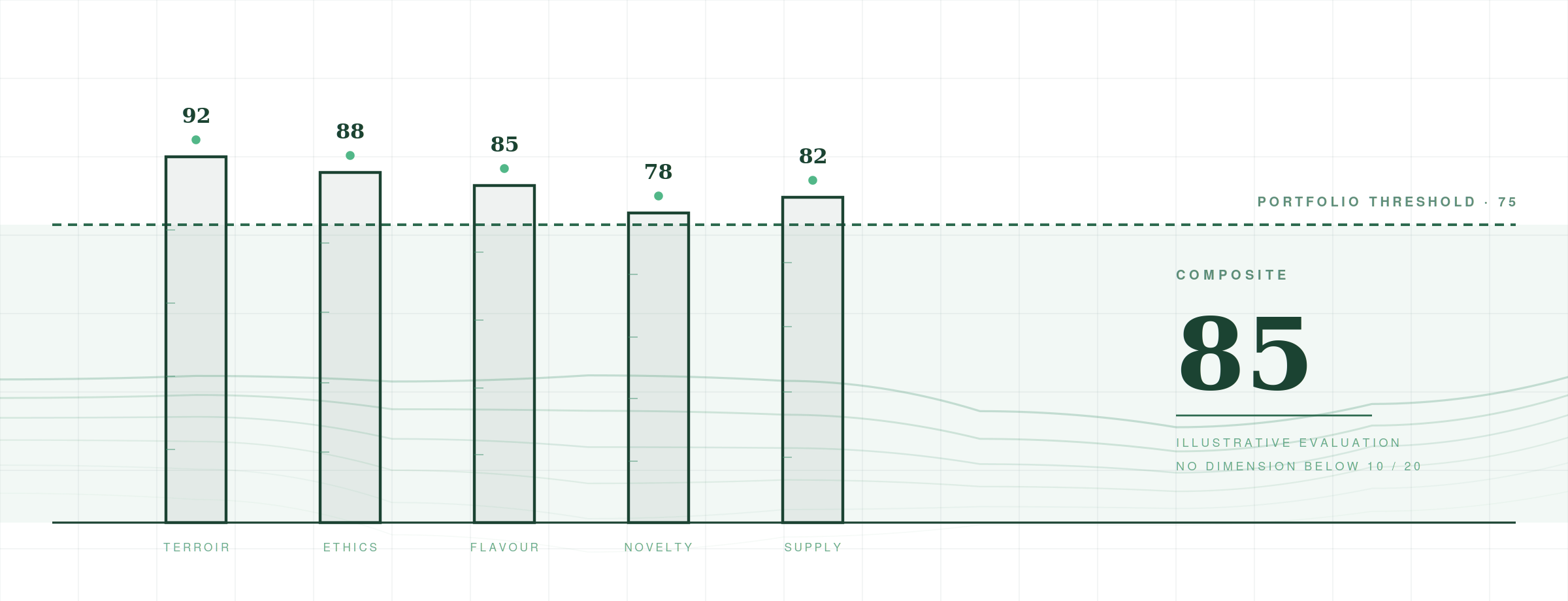
The Origin Index scores every product we consider across five dimensions, each out of 20, for a composite out of 100.
Terroir Authenticity — is this product genuinely shaped by its place of origin, or could it have been made anywhere?
Production Ethics — is it made responsibly, fairly, and sustainably, with documentation rather than assurances?
Flavour Distinction — does it offer something the target market cannot easily find elsewhere?
Market Novelty — is there a genuine, underserved demand this product can fill?
Supply Reliability — can the producer deliver consistently at the volume, quality and timeline required?
A product needs 75 out of 100 to enter the portfolio. It also needs at least 10 out of 20 on every single dimension, regardless of composite — a hard floor that exists specifically so an outstanding total cannot mask one serious weakness.
Each dimension has a written five-level rubric with observable criteria, and category-specific guidance that changes what evidence we gather depending on whether we are assessing coffee, wine or artisan FMCG. For coffee we run formal cupping under SCA protocols with at least two independent scorers. For wine we taste blind against competitive benchmarks from the destination market and reference independent critic scores where they exist.
The equal weighting is the argument
The design decision people question most is that all five dimensions carry the same weight. Surely flavour matters more than market novelty? Surely origin authenticity is the whole point of a company called Terra Vero?
We weighted them equally on purpose, and the reasoning is the core of the whole system.
A product scoring 20 on Flavour Distinction and 5 on Supply Reliability will damage our relationships with buyers the first time an order cannot be filled. A product with flawless logistics and no flavour distinction offers a buyer nothing they could not get more cheaply elsewhere. A product that scores well on everything except Production Ethics is a reputational liability waiting for a journalist.
Equal weighting forces the evaluator to confront all five honestly rather than letting a strong first impression carry the assessment. That is not a statistical claim about the relative importance of the dimensions. It is a behavioural safeguard against the specific way humans evaluate things they have already decided they like.
What the framework is not
We should be precise about the limits, because overstating a methodology is its own kind of dishonesty.
It is not objective. A trained evaluator applying a written rubric is still making judgements. The rubric constrains and documents those judgements; it does not eliminate them. Two competent people can score the same lot three points apart on Flavour Distinction and both be defensible.
It is not a ranking tool. The Index answers whether a product meets our standard, not which of two products is better. Comparative scoring is a useful by-product, not the purpose.
It is not a substitute for commercial due diligence. A product can clear 85 and still be wrong for us on pricing, logistics cost or regulatory complexity. The Index determines whether something is worth taking seriously. It does not determine whether we can make money on it.
It is not permanent. We review the methodology annually and version-control the changes. Archived evaluations stay scored under the methodology in force when they were conducted, because retroactively restating scores would make the record useless.
Why we score sequentially and never adjust backwards
One procedural rule does more work than any other: score each dimension in order, without looking ahead to the running total, and never revise an earlier score because the composite is trending somewhere you did not expect.
If the total surprises you, that is information. It means the product's strengths and weaknesses are distributed differently from your initial impression — which is precisely what the framework exists to surface. Adjusting backwards to reach a number you had already decided on converts the whole exercise into theatre.
We have declined products we personally loved. That is the system working, not failing.
What it gives a buyer
The internal discipline is the primary purpose, but the framework does something else that matters commercially.
When we bring a product to a roaster, retailer or hotel group, we can explain exactly why it is in the portfolio and where it is weakest. A buyer receiving a coffee from us knows it scored 84, that the strength was terroir authenticity and the relative weakness was supply reliability, and that we are monitoring batch consistency across the first two shipments as a result.
That is a different conversation from "we think this is great." It respects the buyer's own judgement rather than asking them to substitute ours for it, and it makes us accountable in a way a recommendation never is. When a product underperforms, there is a written record of what we thought and why — including what we got wrong.
We also share evaluations with producers, including the ones who fall short. A producer who scores 68 gets told which dimensions cost them and what would need to change for a re-evaluation in six to twelve months. Several have come back stronger. That only works because the assessment was written down.
The uncomfortable part
The framework's most useful property is that it regularly tells us things we would rather not hear.
It has kept us out of products with beautiful stories and unreliable supply. It has forced us to decline producers we liked personally. It has occasionally made a coffee we found unremarkable score higher than one we were excited about, which is genuinely irritating and almost always correct — because our excitement was measuring one dimension and the Index was measuring five.
Curation sounds like a matter of taste. In practice, taste is the easy part. The discipline is in the four questions you would rather not ask once you have already fallen for something.
The full Origin Index™ methodology, including scoring rubrics and category-specific evaluation guidance, is documented internally and available to trade partners on request.