
The Gulf Is South African Wine's Quietest Success Story
South African wine has spent several years in a difficult global market. Consumption is contracting in most mature markets, stock levels are elevated, and pricing pressure is constant. Against that backdrop the export numbers have been respectable rather than exciting — modest value growth on broadly flat volume.
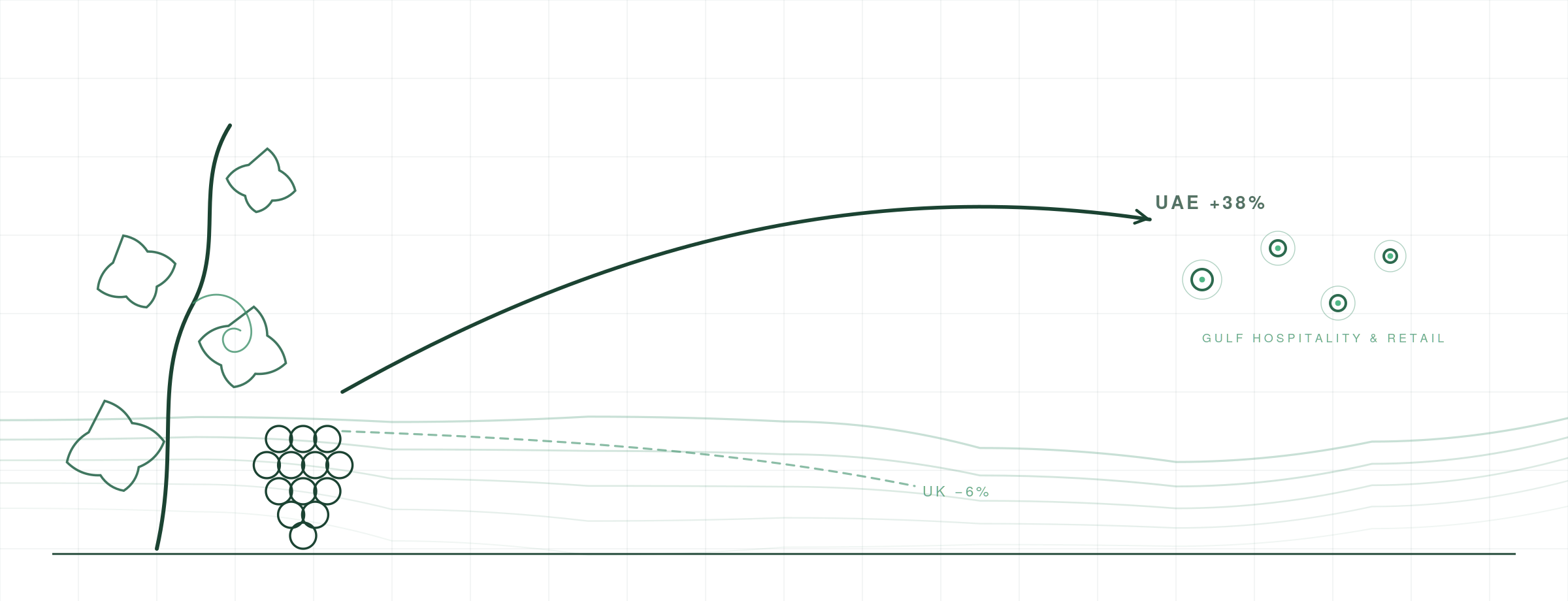
Inside those aggregate figures, though, one market has been behaving very differently. Exports to the United Arab Emirates grew 38%, at a time when the United Kingdom — still comfortably South Africa's largest wine market by value — declined 6%.
That is a large enough divergence to be worth taking seriously rather than filing as noise.
What is driving it
The Gulf wine opportunity is a convergence of three things happening simultaneously.
Regulatory liberalisation. Abu Dhabi Global Market has been granting alcohol service permits, demonstrating a regulatory flexibility that would have been difficult to imagine a decade ago. Saudi Arabia's 2026 move to permit controlled alcohol sales within designated tourism zones extends the addressable market further. These are carefully bounded changes, not a general opening, but they are real and they are directional.
Tourism and hospitality investment. Both the UAE and Saudi Arabia are investing enormously in hospitality infrastructure aimed at international visitors. Hotel groups, resort developments and fine-dining operations all need wine lists, and those lists need points of difference.
Consumer premiumisation. Rising urban affluence across the region has pushed consumption toward premium labels, supported by sophisticated drinking occasions and a strong corporate gifting culture. The Middle East and Africa wine market as a whole is growing at roughly 5–6% annually against a global backdrop of contraction.
Why South African wine fits this market unusually well
There is a structural reason the Gulf suits South African producers better than it suits many competitors, and it is not price.
Gulf buyers — particularly in hospitality — are looking for wines that give a sommelier something to say. The region's wine service is heavily oriented toward guest experience, and a wine that carries a story about a specific place, a specific soil, or a specific old vineyard block does work that a competent but anonymous varietal cannot.
South Africa's competitive position has been shifting in exactly this direction. The industry is leaning harder on quality, vineyard site and regional identity to distinguish itself in a crowded market, with tighter supply control and stronger emphasis on origin-led branding. The categories showing the strongest export growth have been the ones with the most to say: sparkling wine, Cap Classique, and Blanc de Noir and rosé, while bulk dry white and red blends declined.
The 2026 vintage supports that positioning. Producers described a technically demanding "pendulum season" — dry conditions, February rainfall, intense late-season heat — that nonetheless delivered concentrated wines with genuine premium potential across Chardonnay, Sauvignon Blanc, Chenin Blanc, Pinotage and Cabernet Sauvignon. The national harvest came in around 1.370 million tonnes, a moderate recovery after several small vintages.
A difficult season producing concentrated fruit is a good story, and it happens to be true.
The parts nobody puts in the press release
Three things temper the enthusiasm, and they should be understood before anyone books a flight to Dubai.
Route to market is licensed and narrow. Alcohol import and distribution in the Gulf runs through a small number of licensed operators. You do not simply appoint a distributor; you secure a relationship with one of a limited set of gatekeepers, and their portfolio priorities determine whether your wine gets attention or shelf space. This is a relationship market with a genuinely restricted entry point.
Documentation is exacting. Labelling requirements, import permits, excise treatment and certificate requirements are all more prescriptive than most exporters expect. Getting this wrong does not produce a polite request for correction; it produces a container sitting at port accruing costs.
Competition is not asleep. Australian, Chilean, Argentine and European producers are pursuing the same growth for the same reasons. South Africa's advantages are quality-per-rand and a differentiated story, not incumbency.
What we would tell a wine estate
If you produce premium South African wine and you are considering the Gulf, the sequencing matters more than the ambition.
Start with the underrepresented rather than the obvious. Established Stellenbosch Cabernet has competition in every market on earth. Swartland, Elgin and Cederberg have far less international presence, and varietals like Cinsault, Semillon and Grenache are genuinely differentiated in a market saturated with the international five.
Bring your documentation before your samples. The estates that move fastest through Gulf market entry are those whose Wine of Origin certification, WIETA status, export registration and labelling compliance are already in order. Sorting this out while a buyer waits is the most common cause of a promising conversation going quiet.
Treat sparkling and Cap Classique seriously. These are the fastest-growing South African export categories, and they map neatly onto the Gulf's celebration and hospitality occasions.
Our position
Terra Vero runs South Africa into the Gulf as one of four active corridors, and it is the one where we think the gap between opportunity and current exploitation is widest.
The reasoning is straightforward. A market growing 38% while the traditional anchor market declines is telling you something about where attention should go. Most South African export effort is still pointed at Europe out of habit. That is not irrational — Europe still takes 26% of South African agricultural exports — but habit is a poor allocator of scarce commercial attention.
We would rather be early in a licensed, difficult, growing market than late in a comfortable, contracting one.
Sources: Wines of South Africa export data; South African 2026 harvest reports; Mordor Intelligence, Middle East and Africa Wine Market analysis 2026; Abu Dhabi Global Market licensing announcements; Agbiz agricultural trade data, Q1 2026.