
The December Deadline: What the EU Deforestation Regulation Means for Coffee Buyers in Africa
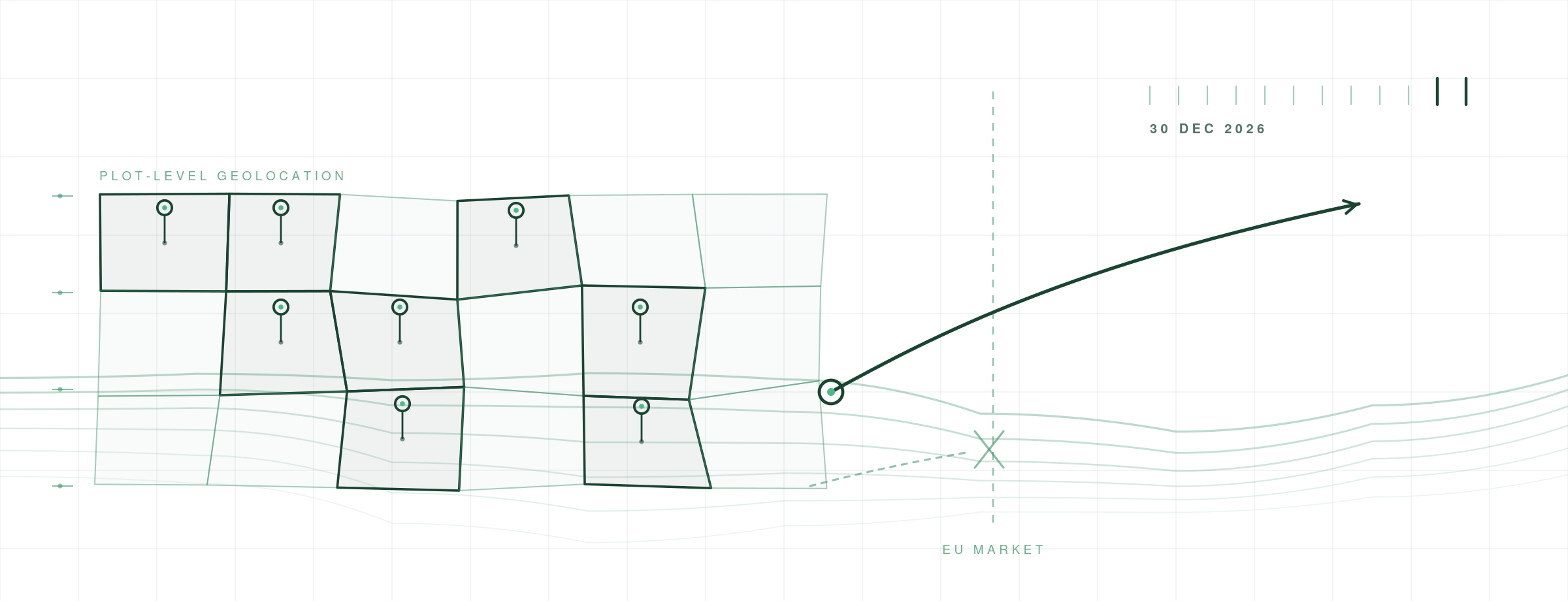
From 30 December 2026, every consignment of coffee placed on the European Union market must be accompanied by plot-level geolocation data, a due diligence statement, and documentary proof that the land it grew on was not deforested after 31 December 2020.
That is the EU Deforestation Regulation, and after two full-year postponements it now looks likely to hold. Large and medium operators face the December 2026 date; micro and small enterprises have until 30 June 2027.
For anyone buying African coffee, this is the single most consequential piece of regulation in the sector's recent history — and it is worth being clear about why.
The problem is structural, not administrative
Coffee is grown in more than sixty countries, and the large majority of the world's coffee comes from farms of under five hectares. A single export container routinely holds beans from hundreds of individual smallholders, aggregated by local collectors, passed to cooperatives, consolidated by exporters, and sold on to international traders before a roaster ever sees it.
Each of those handoffs traditionally erased information. That was not negligence — it was how the system was designed to work. Volume was the unit of value, and volume is fungible. Nobody was paid to remember which slope a particular sack came off.
The EUDR inverts that logic entirely. It requires end-to-end traceability to the farm, which means the aggregation step that made the industry efficient is precisely the step that now creates legal exposure.
The cost falls where you would expect
Published estimates put post-simplification compliance costs at roughly €15–40 per tonne for cooperative-structured supply chains, rising to €40–80 per tonne where intermediary buyers sit between the farm and the exporter. Integrated plantation supply chains — where one entity owns and maps everything — come in far lower.
Read that spread carefully, because it describes a competitive reallocation. The origins best placed to absorb EUDR are large estates with GPS-mapped boundaries and in-house legal capacity. The origins least placed are the fragmented smallholder systems that produce much of the world's most distinctive coffee.
There is a real risk that a regulation designed to protect forests ends up quietly consolidating the supply base.
What is actually working
The picture is not uniformly bleak. Producer organisations across East Africa have made genuine progress on farm mapping and geolocation data collection, and certification bodies report that a substantial share of already-certified supply chains are close to alignment.
The most useful development is the voluntary grouping provision introduced in the 2026 simplification package. A cooperative can now map all of its member farms and file one consolidated due diligence statement rather than hundreds of individual ones. For smallholder-based origins this is the difference between viable and impossible, and it rewards exactly the organisational structure — the well-run cooperative — that tends to produce the best coffee anyway.
Every major African coffee origin, including Ethiopia, Kenya, Rwanda, Uganda, Tanzania, Burundi, Cameroon and the DRC, was classified as standard risk in the European Commission's benchmarking. Standard risk means full due diligence applies. It does not mean these origins are presumed guilty, and it does not mean they cannot comply.
The second-order effect: trade re-routing
Ethiopia is already diversifying away from regulated Western markets. As of 2026, well over half of Ethiopian green coffee exports go to Asia, with Saudi Arabia alone taking roughly a quarter. Rwanda's record export year in 2025 was driven substantially by Middle East buying.
This matters to anyone sourcing into South Africa or the Gulf, and it cuts both ways.
The optimistic reading is that non-EU buyers gain access to excellent coffee that European roasters can no longer easily clear. The realistic reading is that the best lots will still command global prices, and that a two-tier market — EUDR-compliant and everything else — is a poor long-term position for any origin to be locked into.
Where we sit
Terra Vero does not currently place coffee on the EU market. We could therefore treat December 2026 as somebody else's problem.
We don't, for three reasons.
The first is that traceability is not a compliance artefact for us. Two of the five dimensions in our Origin Index — Terroir Authenticity and Production Ethics — already require lot-level origin documentation before a product enters the portfolio. We ask for the farm, the altitude, the varietal, the processing method and the farmgate price as a matter of course, because we cannot score a product without them. A supplier who can answer EUDR can answer us.
The second is that regulation travels. The EU is rarely the last jurisdiction to adopt a standard, and provenance requirements are already appearing in buyer specifications well outside Europe. Building the data infrastructure now is cheaper than retrofitting it later.
The third is more straightforward: the producers who have done this work deserve buyers who value it. If a Rwandan cooperative has mapped every member farm and can produce a consolidated due diligence statement, that is a signal about how the organisation is run. It correlates strongly with the things we actually care about — consistency, quality control, and the ability to fulfil a repeat order.
What buyers should be doing now
If you import coffee, three things are worth attention before the end of the year.
Map your exposure honestly. Not which of your suppliers claim compliance, but which can produce geolocation data on request today. The gap between those two numbers is your actual risk.
Pre-contract earlier than usual. Compliant lots will tighten well before the deadline as European buyers secure supply. This is a market where waiting costs money.
Talk to cooperatives directly. The grouping provision has made well-organised producer cooperatives structurally advantaged for the first time in years. That is a rare opening, and it will not stay open indefinitely.
Sources: European Commission Regulation (EU) 2023/1115 and the December 2025 amendment; International Coffee Organisation readiness assessments; Rainforest Alliance and Fairtrade International compliance reporting; industry compliance cost estimates published mid-2026.