
Buying Coffee in an Expensive Market: Notes From the 2026 Price Cycle
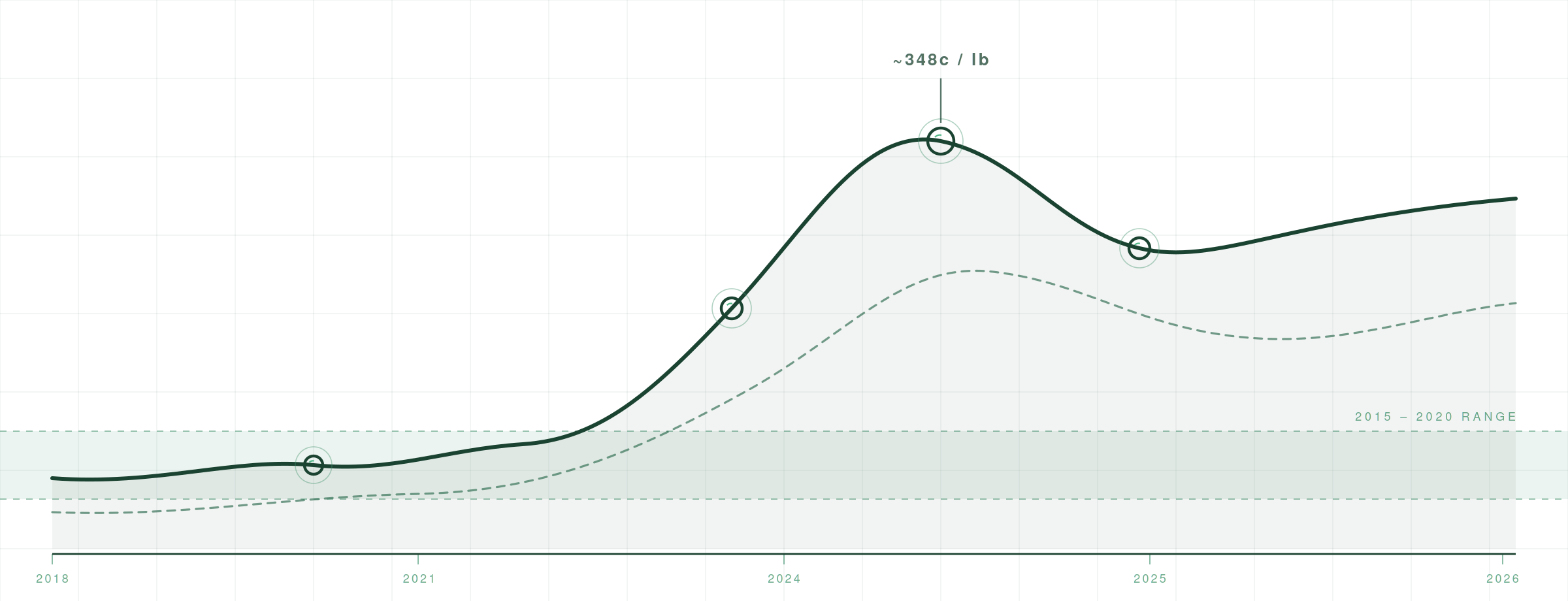
The ICE New York C-market — the benchmark for Arabica futures — traded at approximately 348 cents per pound in March 2026. Between 2015 and 2020 that same contract averaged somewhere between 110 and 150 cents. The market has cooled from its panic high, but it has not returned to anything resembling the old normal, and there is no credible scenario in which it does so quickly.
The causes are well documented and mostly agricultural. Brazil, which produces something like 35–40% of global output, took severe frost damage in 2021 followed by persistent drought. Replanted trees need three to five years to reach full productivity, and the 2026 harvest remains below historical averages. Vietnamese drought cut Robusta production hard enough to push Robusta above US$4,000 per tonne in early 2026, which sent substitution demand back toward Arabica origins.
For anyone buying specialty coffee, the practical question is not why prices rose. It is what to do now.
Where African origins actually sit
The headline futures number obscures more than it reveals, because specialty lots do not trade at the C-market. They trade at a differential to it, and those differentials tell a more useful story.
Ethiopian G1 and G2 specialty lots have been commanding FOB prices in the range of US$5.00 to US$7.00+ per pound. Yirgacheffe and Guji consistently sit at the top of the Ethiopian range on the strength of global specialty demand; Sidamo follows closely; Jimma and Limu trade lower and more commercially.
Kenya AA has been trading around US$8–10 per kilogram FOB Mombasa for standard auction lots at the Nairobi Coffee Exchange, with premium micro-lots reaching US$12–15/kg. Kenya AA averaged roughly US$454 per 50kg bag through the 2025/26 season. Against Brazilian commodity Arabica at US$4–5/kg, that is roughly a 2× quality premium — and that premium is what partially insulates Kenya from a general price correction.
Rwanda set a national record in 2025 at approximately US$148.6 million in coffee export earnings, with volume up 39% year on year. The driver was notably not Europe: stronger Middle East buying carried much of that growth, alongside continued European and US demand.
The substitution trap
When green prices rise, the standard response is to move down the quality ladder or swap origins. Both are usually mistakes in specialty, and it is worth being specific about why.
Moving down the ladder does not save what buyers expect it to. The gap between a coffee scoring 82 and one scoring 86 is a meaningful cup difference but a comparatively modest price difference at origin. Meanwhile the retail price you can defend collapses much faster than the green cost you saved. You compress your own margin to protect a line item.
Swapping origins wholesale is worse. Kenya and Rwanda can ease flavour continuity at the margin, but neither can replace Ethiopia's scale in cup-specific niches. A washed Yirgacheffe and a washed Rwandan Bourbon are both excellent and they are not interchangeable — your customers will notice, and the ones who notice are the ones paying your premium.
The sensible hedge is to pre-position small volumes of substitute profiles so you understand them before you need them, rather than pretending a swap can be executed at volume under pressure.
What experienced buyers are doing instead
Three behaviours separate the operations handling this cycle well from the ones absorbing it badly.
They pre-contract, and earlier than feels comfortable. In a tight market, availability becomes the binding constraint before price does. Contracts that protect delivery windows are now being negotiated as aggressively as contracts that protect price — which is a genuine change in how the trade behaves.
They buy relationships rather than lots. A buyer who has worked with an exporter across three seasons gets offered the good lots first. In an oversupplied market that advantage is pleasant; in a tight one it is decisive. This is not sentimentality, it is allocation.
They communicate value transparently downstream. The roasters struggling most are those who spent a decade competing on shelf price and now have no vocabulary for explaining a rise. The ones handling it well have been telling origin stories all along, so a price move reads as scarcity of something specific rather than opportunism.
The South African angle
For roasters in Johannesburg, Cape Town and Durban there is an additional variable: the rand. Import costing in a high green market with a volatile currency compounds risk in a way that dollar-denominated buyers do not face.
Two practical responses. Price imports in rand with a built-in currency buffer of 8–10% rather than passing through raw exchange movement, and use forward cover on confirmed orders rather than open exposure. Neither is exotic; both are frequently skipped by smaller importers who then discover their margin was a currency bet.
There is also an opportunity here that the price environment partly creates. As Ethiopian export flows re-route toward Asia and the Gulf, and as EUDR compliance costs weigh on European buying, South African roasters are competing for allocation against a slightly different field than they were three years ago. That is not a reason for complacency, but it is a reason to build direct origin relationships now rather than after the next squeeze.
What we do about it
Our Origin Index scores Supply Reliability as one of five equally weighted dimensions, and it is the one buyers most often underrate. A coffee can be exceptional in the cup and still be the wrong purchase if the producer cannot deliver consistently at the volume and timeline required.
In a market like this one, that dimension does more work than usual. We would rather carry a coffee scoring 84 from a cooperative with three successful export seasons behind it than an 88 from a producer who has never shipped a container. The first is a business. The second is a hope.
Sources: ICE New York C-market data, March 2026; Nairobi Coffee Exchange auction data, 2025/26 season; Ethiopian Commodity Exchange indicative FOB ranges, 2025/26 crop year; Rwandan national coffee export earnings, 2025; StoneX Africa coffee outlook, April 2026.